How Ultrasonic Spray Coating Supports Hydrogen Production
Hydrogen electrolyzers require highly uniform functional coatings on electrodes and membranes to achieve efficient electrochemical reactions.
Traditional coating methods may suffer from:
- uneven catalyst distribution
- excessive material consumption
- poor thickness control
- coating defects on delicate substrates
Ultrasonic spray coating provides a low-pressure, high-precision coating solution by generating micron-sized droplets through ultrasonic atomization.
This allows manufacturers to deposit catalyst inks and functional materials with controlled thickness and excellent uniformity.
Key Application Areas
1.PEM Electrolyzer Electrode Coating
PEM (Proton Exchange Membrane) electrolyzers require advanced catalyst layers on electrodes to improve hydrogen generation efficiency.
Ultrasonic spray coating can be used for:
- Iridium oxide catalyst coating on anodes
- Platinum catalyst coating on cathodes
- Catalyst ink deposition on porous transport layers
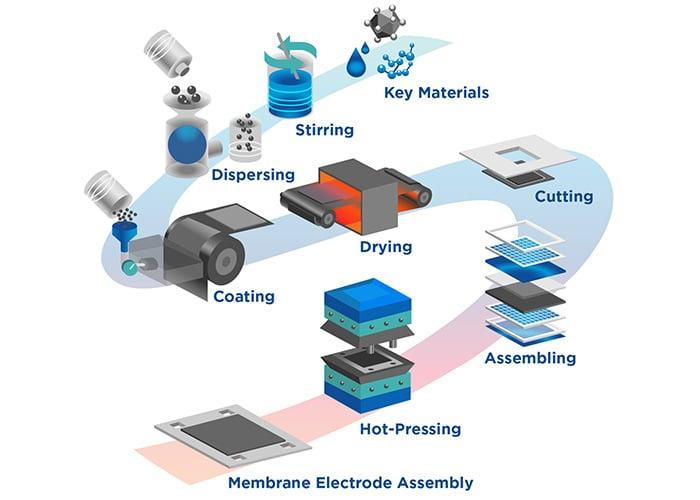
- Membrane electrode assembly (MEA) fabrication
Advantages:
✓ Precise catalyst loading control
✓ Uniform catalyst distribution
✓ Reduced precious metal consumption
✓ Suitable for research and pilot production
2. AEM Electrolyzer Coating
Anion Exchange Membrane (AEM) electrolyzers are emerging hydrogen production technologies.
Ultrasonic coating enables:
- catalyst layer fabrication
- ionomer dispersion coating
- electrode surface modification
Benefits:
- thin and uniform functional layers
- improved electrode performance
- flexible material compatibility
3.Porous Transport Layer (PTL) Functional Coating
Electrolyzer components often require surface modification to improve:
- corrosion resistance
- electrical conductivity
- water/gas transport performance
Ultrasonic spray coating can apply:
- metal oxide coatings
- conductive coatings
- protective layers
onto:
- titanium substrates
- stainless steel components
- porous metal structures
4.Hydrogen Fuel Cell Related Coating
Although fuel cells are not hydrogen production devices, they share similar MEA manufacturing technologies.
Ultrasonic coating is widely suitable for:
- catalyst layers
- microporous layers
- gas diffusion electrode coatings