
Ultrasonic Spray Coating for Solar Cells
The performance of a solar cell depends heavily on the quality and consistency of its functional layers. Variations in coating thickness, surface coverage, or material distribution can reduce device efficiency and lead to inconsistent production results.
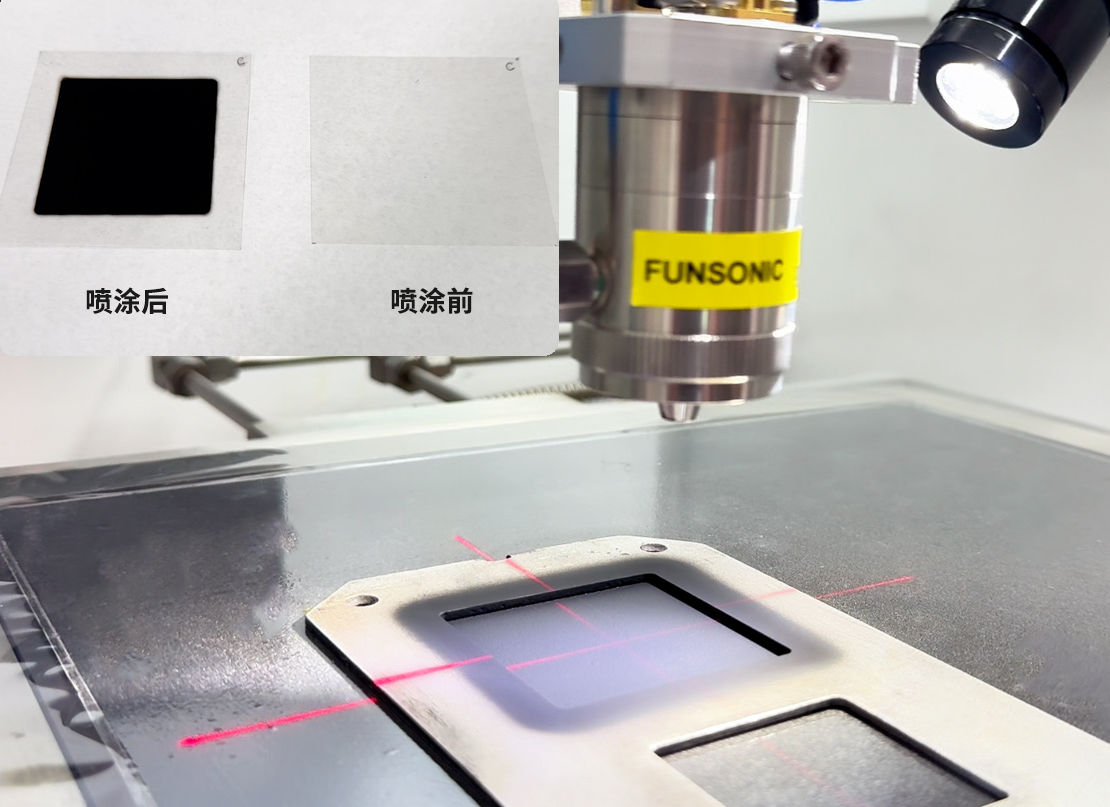
Ultrasonic spray coating converts a liquid formulation into a fine, uniform mist using high-frequency vibration. Combined with precise motion control, liquid delivery, substrate heating, and optional shaping air, it enables repeatable deposition of thin functional films on photovoltaic substrates.
This non-contact coating method is suitable for laboratory research, process development, pilot production, and integration into automated solar cell manufacturing lines.
Solar Cell Coating Challenges
Photovoltaic coating processes often involve expensive materials, sensitive formulations, and strict film-quality requirements. Common challenges include:
- Achieving uniform film thickness across the substrate
- Controlling coating coverage and edge definition
- Reducing pinholes, streaks, and local material accumulation
- Minimizing overspray and material waste
- Depositing thin layers without damaging the underlying surface
- Maintaining repeatability between samples and production batches
- Scaling a laboratory coating process to larger substrates
- Integrating coating, heating, drying, and motion control
Conventional spray methods may generate large or inconsistent droplets, resulting in poor surface uniformity and excessive material consumption.
Our Ultrasonic Coating Solution
Our ultrasonic spray coating systems generate fine, low-velocity droplets for controlled deposition on solar cells and photovoltaic components.
The coating process can be adjusted through liquid flow rate, nozzle power, spray width, nozzle-to-substrate distance, motion speed, coating path, substrate temperature, and the number of coating passes.
Key process advantages include:
- Fine and uniform droplet generation
- Precise control of coating thickness
- High transfer efficiency and reduced material waste
- Low-velocity spray with limited overspray
- Repeatable multi-pass deposition
- Compatibility with automated motion platforms
- Adjustable spray width for different substrate sizes
- Easy process development from laboratory to pilot production
Multiple thin coating passes can be used to build the required layer while improving uniformity and reducing defects.
Typical Solar Cell Coating Applications
Ultrasonic spray technology can be evaluated for depositing various functional layers used in photovoltaic research and manufacturing, including:
- Perovskite precursor layers
- Electron transport layers
- Hole transport layers
- Anti-reflective coatings
- Passivation layers
- Conductive nanoparticle coatings
- Transparent conductive material coatings
- Buffer and interface layers
- Encapsulation and protective coatings
- Quantum dot and nanomaterial formulations
- Organic photovoltaic functional layers
- Experimental thin-film solar cell materials
Actual coating performance depends on the formulation, viscosity, surface tension, solid content, substrate properties, drying conditions, and target film thickness.
Compatible Photovoltaic Technologies
The system can be configured for research and process development involving:
- Perovskite solar cells
- Crystalline silicon solar cells
- Thin-film photovoltaic devices
- Organic photovoltaic cells
- Dye-sensitized solar cells
- Quantum dot solar cells
- Tandem and emerging photovoltaic structures
Different nozzle configurations, motion systems, and liquid delivery options are available according to the substrate size and coating requirements.
Suitable Substrates
Ultrasonic spray coating can be used on a variety of flat or structured photovoltaic substrates, such as:
- Silicon wafers
- Conductive glass
- ITO-coated glass
- FTO-coated glass
- Flexible polymer films
- Metal foils
- Ceramic substrates
- Small photovoltaic devices and test coupons
Substrate heating can be added when controlled evaporation, film formation, or drying is required during the coating process.
System Configuration
A typical solar cell coating system may include:
- Ultrasonic spray nozzle
- Digital ultrasonic generator
- Precision liquid delivery system
- Programmable XYZ motion platform
- Heated substrate stage
- Shaping-air control
- Exhaust or enclosed spray chamber
- Process recipe control
- Custom fixtures for wafers, glass, or flexible substrates
The system can be configured as a compact laboratory unit, a pilot-scale coating platform, or a customized module for integration into an automated production line.
Why Use Ultrasonic Spray Coating?
Uniform Thin-Film Deposition
Fine droplets and programmable motion help create consistent coverage across the target area.
Reduced Material Consumption
The low-flow, controlled spray process minimizes overspray and is especially valuable when coating expensive photovoltaic materials.
Flexible Process Control
Key parameters can be adjusted independently to support formulation screening and coating-process optimization.
Repeatable Multi-Layer Coating
Programmable coating paths and repeatable passes support the development of single-layer and multilayer photovoltaic structures.
Scalable System Design
The same spray principle can be applied to laboratory samples, larger substrates, and automated production systems.
Recommended Equipment
Depending on the substrate size, formulation, and target coating thickness, we can provide:
- Laboratory ultrasonic spray coating system
- Programmable XYZ ultrasonic coating machine
- Heated-substrate coating system
- Wide-area ultrasonic spray coating system
- Ultrasonic spray nozzle and generator set
- Customized inline photovoltaic coating module
To recommend a suitable configuration, we normally evaluate the coating liquid, substrate dimensions, target film thickness, required coating width, production capacity, and current process conditions.
Process Evaluation
Before selecting the equipment, the following information is helpful:
- Coating material and solvent
- Viscosity and solid content
- Substrate material and dimensions
- Target coating thickness
- Required spray or coating width
- Laboratory or production application
- Required production speed
- Heating and drying requirements
- Explosion-proof or exhaust requirements
- Existing coating problems
Sample coating tests can be arranged when process validation is required.
Frequently Asked Questions
Can ultrasonic spray coating be used for perovskite solar cells?
Yes. Ultrasonic spray coating can be evaluated for perovskite precursor layers, transport layers, interface layers, and other functional films. The final process parameters must be optimized according to the formulation, substrate, and required device structure.
Can the system coat silicon wafers?
Yes. The system can coat silicon wafers and other flat photovoltaic substrates. Custom fixtures and programmable coating paths can be provided according to the wafer size and coating area.
How is the coating thickness controlled?
Coating thickness can be adjusted through liquid flow rate, nozzle output, motion speed, spray distance, substrate temperature, coating pattern, and the number of coating passes.
Can the substrate be heated during coating?
Yes. A heated substrate stage can be integrated to support solvent evaporation, drying, and film formation during the coating process.
Is ultrasonic spray coating suitable for expensive materials?
Yes. Its low-flow and high-transfer-efficiency characteristics help reduce overspray and material waste, making it suitable for research formulations and other high-value coating materials.
Can the process be scaled from laboratory research to production?
Yes. Laboratory coating parameters can provide a basis for pilot-scale development. Scaling still requires optimization of spray coverage, motion paths, liquid delivery, heating, drying, and production speed.
Can you customize the system for our solar cell process?
Yes. We can customize the nozzle configuration, coating width, motion platform, heated stage, liquid delivery system, enclosure, exhaust design, fixtures, and automation interface.
Find the Right Solar Cell Coating Solution
Tell us about your coating material, substrate size, target film thickness, coating area, and production requirements. Our team will help evaluate the process and recommend a suitable ultrasonic spray coating configuration.